 Instead, the Dryden Aircraft Operations Facility (which could soon be renamed after Neil Armstrong – the first man on the Moon and an ex-Dryden test pilot) , is home to a vast fleet of aircraft that range from small propeller planes to some of the most advanced aircraft in the world.
The mission of the base is to “fly what others only imagine” and over the years it has lived up to its motto.
In the early days of supersonic flight, the huge airfield – conveniently located next to Edwards Air Force base – played a key role in pushing the X-1A through the sound barrier. The centre’s B-52 Stratofortress bomber, also dropped a large number of supersonic test vehicles, including the X-15 -world’s fastest manned vehicle.
Explore Dryden's history in pictures
See Dryden's plane fleet
In addition, the base has seen tests of an astounding array of experimental craft, including solar powered planes, drones fuelled by hydrogen and even planes with inflatable wings.
On top of these extreme prototypes, the base is also home to a longstanding fleet of no less extraordinary craft. Over the years, this has included a modified SR-71 Blackbird, a modified Boeing 747 designed to carry the Space Shuttle and various civilian and military planes heavily modified to carry scientific instruments.
These planes are used for everything from flights into the path of hurricanes, to trips to the edge of space. The information gathered helps in our understanding of the atmosphere, weather and climate, and vulcanology. The planes also allow Nasa to reach the edge of space in a craft that can be brought home again safely, unlike a rocket, which is usually a one-way trip.
Difficult landing
Recently, the base threw open the doors to its hangar to allow me to have a look around.
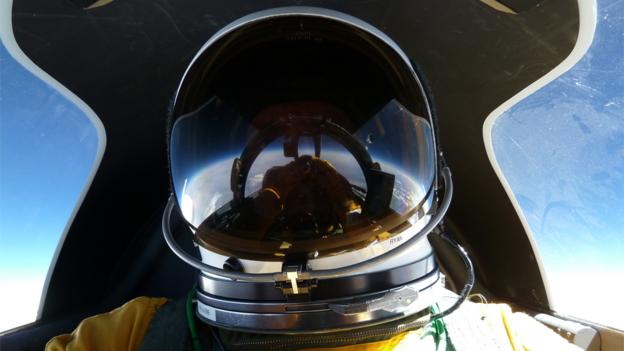
Dominating a large part of the space were two sleek, white Lockheed ER-2 craft. These pencil thin, single-engine craft are a derivative of the very high-altitude U-2 spy planes flown by the US Air Force and Central Intelligence Agency (CIA), which came to prominence in 1960 when CIA pilot Gary Powers was shot down over Soviet territory.
“With an aircraft like the ER-2, which can fly at 20km (over 70,000 ft altitude), we are above 98% of the atmosphere, so often we can simulate a near space environment from it,” says Randal Albertson, deputy director of Nasa’s Airbourne Science Programme.
The planes are also used to improve the performance of satellites, both current and planned.
“They are launched to calibrate and validate the information we are getting from [the satellites],” said Albertson. “Sometimes we go out with instruments before they go to space. We prove the concepts and the techniques.”
The ER-2s also play a vital role in earth science research because of their ability to reach the highest levels of the atmosphere at relatively slow speeds. That means they can be used for sampling missions, and to collect data from remote areas. It was an ER-2, for example, that was used to fly over the Antarctic in 1987 to provide evidence that man-made chemicals (CFCs) were responsible for a hole in the ozone layer.
While the science that the craft perform is often complex, the most difficult task for the plane is the landing. Although it is a single seater aircraft, each mission has two pilots. One of them is onboard, in a high pressure "space" suit, for sometimes over 10 hours. The other stays on the ground, but is in mobile contact.
“He is the backup,” says Randy Albertson. “When it comes to take off and

No hay comentarios:
Publicar un comentario