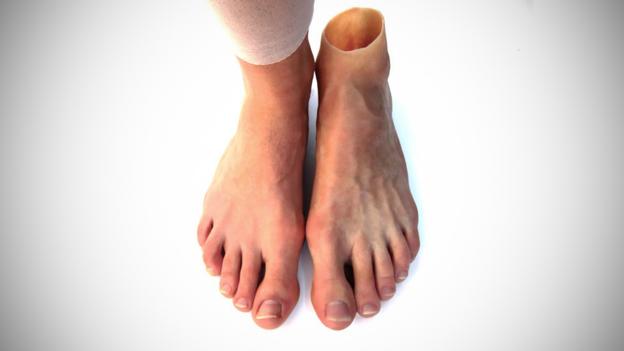
 When Jozef Metelka gets up in the morning, one of his first decisions is which leg he’ll be wearing that day. After losing his right leg in a motorbike accident in 2009, the keen athlete has built up a collection of 12 specialist prosthetics designed to do everything from mountain biking to snowboarding.
Metelka’s first prosthetic leg was a basic model from the UK’s National Health Service, which allowed him to stand and walk, but was “nothing special”. Then he met with specialists at Pace Rehabilitation in Cheadle, UK, and his collection began to grow. The prostheticists at Pace began designing a suite of limbs to get him up and running – and skiing, and biking, and rollerblading. Each time Metelka suggested a new sport, the team designed a corresponding leg.
Creating a prosthetic that performs in all situations with the skill and flexibility of a human limb is, at the moment, not possible. Instead, prosthetics are created with specific goals in mind. Each of Metelka’s legs arrives with a particular design challenge. Weight, strength and durability must all be balanced, as well as considerations about the environment: water, mud, and ice. For downhill mountain biking, the engineers designed a leg that could pivot at the ankle and included a robust shock absorber that could endure the heavy drops down steep hillsides. By contrast, Metelka’s road racing leg is a streamlined flute made from a single piece of carbon fibre, lightweight and very stiff. It was even tested in a wind tunnel.
Metelka is not the only person to covet tailor-made prosthetics. In recent years, an abundance of specialised limbs have emerged, each as individual as the person using them. Farmer David Blum created a special hard-wearing prosthetic leg that could meet the demands of his job, for example, and when motorsport champion Mike Shultz realised his prosthesis wouldn’t stand up to the rigours of racing, he built his own leg out of bike parts.
Designing something that performs on par with a living leg is no mean feat. While on a skiing trip, the freezing conditions caused the titanium bolt in Metelka’s prosthetic to seize, and it had to be cut in two to release the socket and allow a different leg to be attached. But the challenge of building specialist limbs also comes with a certain freedom. Unlike natural limbs, there is no need to compromise for general use. While we can’t build an all-purpose prosthetic as good as a regular limb, it’s very possible to create specialised prosthetics that outperform flesh and blood in their particular category.
 “You can’t do everything to the high level as a regular leg can,” says Metelka. But for specialised legs, he admits that “we are on the verge of building prosthetics that can outcompete natural limbs”. Ahead of the 2012 Olympics, for example, sport governing bodies and biomechanistsdebated whether the prosthetic legs worn by sprinter Oscar Pistorius gave him an unfair advantage against able-bodied athletes. Studies suggested they didn’t, but in five years time, says Metelka, we might even see the emergence of particular sports where able-bodied athletes can no longer hold their own against those who can wear – and can afford – high tech prosthesis.
Out on a limb
Paul Carter is another multiple prosthesis user, albeit with a more modest collection. Born without arms or legs, he owns three pairs of artificial legs, including a set of running blades, the kind made famous by Pistorius. “My blades are designed for a very specific use: running. They are brilliant for what they are, but they’re not practical to wear every day,” he says. The carbon fibre blades act like springs, which means it’s almost impossible to stand still while wearing them. He jokes that the continual hopping from one foot to another makes him look like he needs the toilet.
When he was young, hospital staff and occupation therapists gave Carter a dizzying array of different prosthetics, each designed for a particular task. “I had a tool for everything you can imagine, undoing buttons, putting on trousers, eating, for everything. But as I grew up and got independent, it’s another thing to carry them around. It was like being Robin Hood, having to carry around a quiver of various sticks and rods.” Eventually, Carter decided that he’d rather learn to do things himself than have to rely on a multitude of arms. Both he and Metelka talk about the need to plan ahead to ensure you have the right legs with you for whatever the day holds.
The advent of improved materials such as titanium, carbon fibre and silicone rubber has opened up the world of prosthetics, allowing them to be made lighter, stronger, and better fitting. As well as specialising prosthetics for particular uses, it’s also increasingly popular to customise general-use limbs: from ultra-realistic skins that include hair and tattoos, to more abstract forms. “People tend to go two ways,” says Carter, “some want very realistic limbs, but many more are embracing the fact that they look different, and want to accentuate that fact.”
 The undisputed queen of personalised prosthetics is Sophie de Oliveira Barata, who runs the Alternative Limb Project. Her studio has produced some of the most unique and eye-catching designs in the world, incorporating scales, magnifying glasses, laser pointers, and ultra-realistic features such as freckles (see gallery). For the closing ceremony of the Paralympics, she crafted model Viktoria Modesta a baroque, jewelled leg decked with crystals and mirrors. Even fashion designers are getting in the act – Alexander McQueen designer a pair of intricately carved wooden legs for Paralympic athlete Aimee Mullins. Made without any joints, there weren’t very practical – but that’s hardly an unusual criticism for catwalk creations.
No prosthetic comes cheap. Currently running blades demand a cool $4,000 apiece, while Metelka’s most hi-tech leg – a motorised walking foot – is an eye-watering $90,000. This high cost is the major issue for those wanting to specialise their limbs, says Carter. “If money wasn’t an issue I’d get all the legs I could have,” he laughs. “I’d be the Imelda Marcos of prosthetics.”

No hay comentarios:
Publicar un comentario